

At the fag end of the 15th century, Europeans arrived in South America. They came with the express purpose of looking for sources of wealth beyond their shores. Having heard about the wondrous riches of India, they set out looking for India, and they landed in South America. As their exploration of the continent expanded, almost 50 years after they arrived there, in 1545, the Cerro Rico mountains of Potosi were discovered.

Located in western Bolivia, Potosi was a source of high-quality silver. This resulted in a glut of Silver in Spain. All of the Silver produced in Potosí was taken to Spain. The objective of producing large quantities of Silver was to provide the Spaniards a means to import goods from China, which they desired. Silk, porcelain and many other items produced in China found their way to Spain. It helped that Silver was used as a primary means of exchange in China. Also, Silver was twice the value in China as in Europe.
The flip side of this is that when the price of silver in China began to reach an equilibrium with the rest of the world, Spanish mining profits dried up, its ability to support its ambitions fell, and its status as a world power declined nearly as fast as it had risen. For its part, the Ming Dynasty also suffered as a result of fluctuations in silver prices. With silver losing about ⅔ of its value by the 1630’s it was as if Ming revenue had shrunk by a similar amount. This created a fiscal crisis that was ultimately one of the contributing causes of the fall of the Ming and the emergence of the Qing Dynasty after 1644.
Source: OERI
There is always something, as an oversupply. Even for money. There was too much Silver finding its way to China, and the value of Silver collapsed.
The thing to remember is that it played out over 100 years. Also, remember that the music stops at some point.
Treasury Bonds are issued by governments to raise money when the taxes they collect are insufficient to cover the costs of running the government. The last time the US government had a surplus, it was in 2000. The country has since been consistently running a deficit
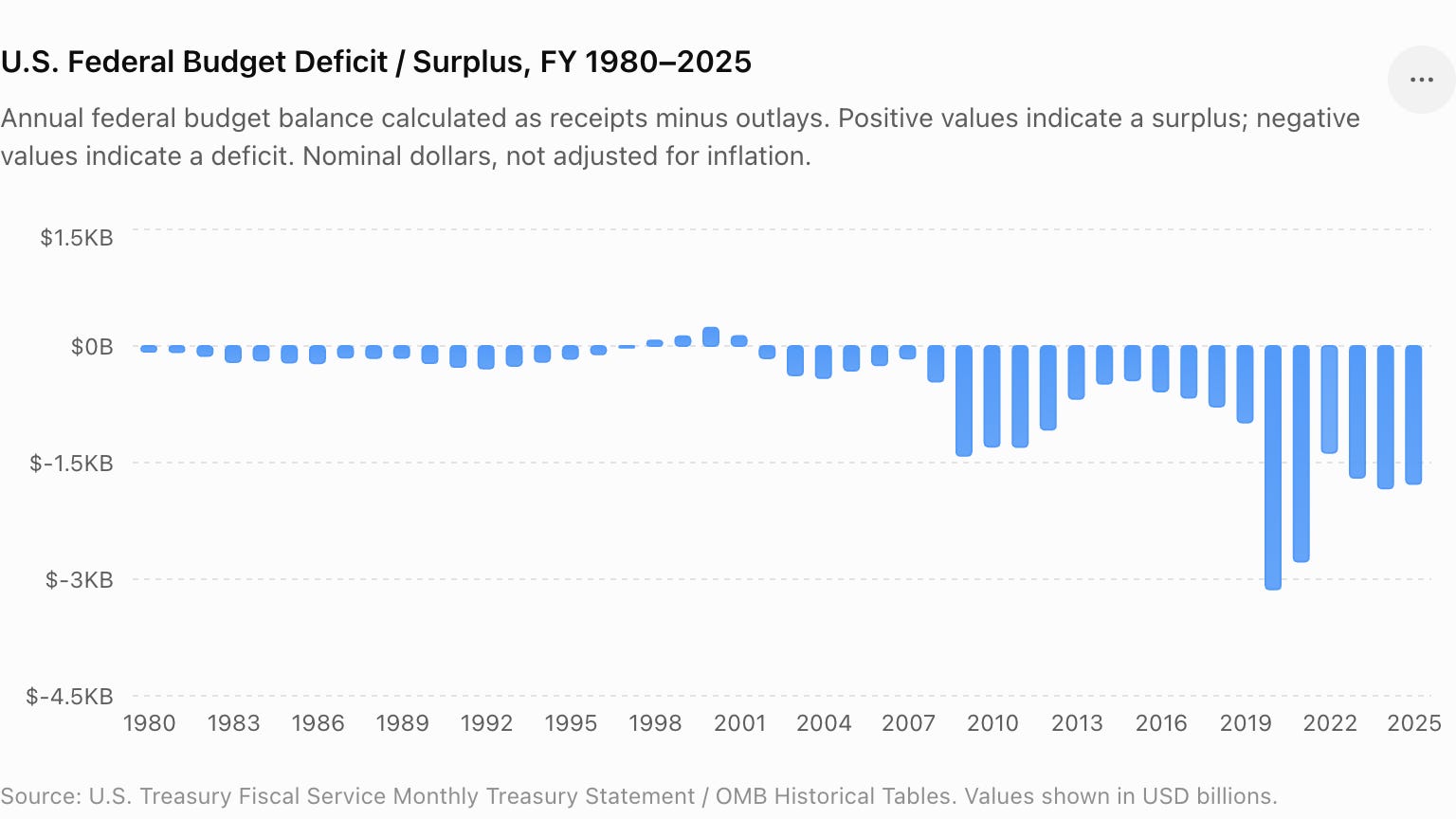
As you can see, the deficit has been rising, or in other words, the spending is greater than the revenue generated. Each time there is a deficit, the US issues bonds to raise capital. The bonds get sold because the US buys a lot of goods from other countries, and those countries park their money in bonds. I had written a piece on how that works 4 years ago.
The country is issuing over $2 trillion in debt each year. The US pays about $1 Trillion in interest each year. The other way of describing the situation is that the country is borrowing to pay out its obligations each year.
Just like the Silver in the 1630s, there is a likelihood that the treasury bond supply becomes excessive. This will result in a loss of value of that asset. In the bond market, this plays out in the form of a rising interest rate. It is happening.
The demand for the debt is declining. The last sale of treasury bonds in mid-August was issued at 4.683% on an issue of $67 billion.
An initial decline in the value of the US debt will hurt those who are holding the debt, since the yield may rise and the price of the bond itself may decline. Eventually, the price of new issues will be higher and higher, which will translate into actual interest payments. If they are unable to bring down that interest rate, at the current levels, the interest payouts will climb to $2.5 trillion.