

In the year 2000, if you were to go to a grocery store in India, few of them would have even had a Point of Sale (PoS) machine, which is used to process debit and credit card payments. First of all, those machines required a telephone connection connected to the internet. Mobile penetration was a low single-digit number, and it cost Rs 32 per minute to make a phone call. Inflation-adjusted, that is like paying Rs 146 per minute today. You could find those machines only at fancy hotels and upmarket locations.
Fast forward a decade to 2010, and the machines were ubiquitous. Internet and mobile penetration had skyrocketed, and the first internet businesses such as Naukri.com, Bharatmatrimony.com, makemytrip.com and several others had found their way to being listed on the market. The payment rails were still run by two American companies: Visa and Mastercard. The RBI had launched both NEFT and RTGS in 2005 and 2004, respectively, but the transaction volumes that they processed were smaller than those of Visa and Mastercard.
One of the ways to grow an economy is by reducing transaction costs. Reducing that friction means making processing faster, easier, ubiquitous and secure. The RBI had been experimenting with Mobile payments, and the MMID was introduced, but it never took off.
In 2008, the RBI, along with some of the largest banks in India (Indian Bankers Association), launched a company called the National Payments Corporation of India. This organisation was tasked with producing protocols that would run the payment rails for the future. A future where the internet and the mobile phone are ubiquitous.
2008 was a time of great change; the iPhone was launched. The world was introduced to something called 3G that made desktop-quality web access possible over the phone. It would go on to upend business models and reshape entire industries over the next decade. You would not hail a cab the same way again, shopping would mean something totally different, and travel agents who sold airline tickets would disappear.
In March 2009, the RBI reported a mere 6 non-cash transactions per capita. At the time, 10 million retailers accepted payments through cards.
On that note, a detour. The transactions made through credit and debit cards are subject to a fee. This fee is called the merchant discount rate. The reason it is called a merchant discount is that when you make the payment, the money does not go directly from your bank to the merchant’s bank.
Those are the two ends of the transaction. In between them sit Mastercard or Visa, which provide the rails for the money to move, and a company like Ingenico would have supplied the machine to the merchant and would be acting as a payment gateway. All these four companies - 2 banks, a payment gateway and a secure transaction layer - are providing IT services for money to move from one destination to another.
To cover the cost, they would debit their fee even before the money reached the merchant’s bank. The fee would be discounted: the merchant discount rate. In India, for card transactions, the MDR is usually about 2%. If you pay Rs 1000 to PVR using a debit card, they get Rs 980 credited into their accounts. That 2% is split between the 4 parties, with the banks taking the lion’s share.
In the US, the MDRs stand at about 3.5%. If you use a service like PayPal, it can go up to 5% even.
The RBI decided that there was a need to create a mobile protocol for transactions to smooth the flow of money.
Also in 2009, 50% of the Indian population was unbanked. They had never had a bank account. This meant that they could never participate in formal channels of credit and were ripe for exploitation by local moneylenders who would charge interest rates as high as 500% per annum.
On 11 April 2016, UPI was launched in India. I would not be surprised if you had not heard of UPI even after the demonetisation in 2016.
Some would have you believe that the success of UPI was a masterstroke by the government or that demonetisation had a huge role to play in the success of UPI.
UPI was indeed kept free by the government. The reason for this was to keep it from failing, much like MMID did. If 15 people are transacting Rs 5000 amongst themselves, even if you have a 2% MDR, what are you going to make? You would be better off sitting with a bowl at the corner of a street. The government’s contribution to the success of UPI ended with making it free.
In August 2010, two companies were founded just days shy of each other. One was based out of Noida and another in Bangalore. Paytm and Freecharge were working on the same thesis. Making payments for phone recharge is difficult. At the time, the use of prepaid connections was very high, ~90% of the market. In order to recharge the phone, you would go to any kirana store, where you would have to spell out your mobile number and pay the amount you wanted to recharge your phone. Sometimes the shopkeeper would get the number wrong and process the payment to the wrong number. If you needed to recharge your phone at 11 pm, LOL.
Both companies wanted to make this easy, and with the rising use of mobile internet, the introduction of the smartphone and the use of debit cards in India, they had a clear case.
In 2009, the RBI had also introduced a draft guideline for what they called a Pre-Paid Instrument (PPI). We all know them as wallets. Paytm did not launch one till 2014, and it was a huge success. Their masterstroke at the time was to integrate it with Uber, which had just launched in India. Credit card penetration was very low in India, and Uber unfortunately worked only with credit cards because debit cards did not allow pre-authorisation (Blocking the sum in advance). The Paytm wallet expanded its market in a huge way.
So by the time that the demonetisation swept around in 2016, Paytm was the default payment method across the country.
I remember landing in Mumbai the day after demonetisation. I had taken a cab to a venue. Along the way, every bank had hundreds of people standing in line. I did not have the time. I asked the driver, ‘Paytm loge’. He told me he did not have an account on Paytm. I had to find the one cab driver still living in the Stone Age. I implored him to create an account. He was very resistant. I realised that the app was in English, and he did not read or write English. He was afraid that he would be locked out of the account because he could not remember the password.
Paytm played loose and dirty, so all I needed was a phone number to get his account opened at the time. I got his account set up in a couple of minutes. Wrote the password on a piece of paper he had, transferred it, and left.
Post-demonetisation, the Paytm wallet was the urban lifeline.
UPI was not even on the horizon. But Venture Capitalists were.
Sameer Nigam was an employee at Flipkart who was thinking of creating a payment solution at the company. The founders had given him the latitude to experiment with ideas. In 2015, he incorporated a company called PhonePe, and it was almost immediately acquired by Flipkart. Paytm had a huge jump on him, so instead of a wallet, he chose to build his product for UPI.
The Indian payment space was ripe for disruption. VCs were pouring money into the space. Many of the companies, including Razorpay, Mobikwik, and Pine Labs, raised a lot of money during this time and the payments race began to heat up.
PhonePe had hitched its wagon to UPI and started heavily promoting UPI codes - the QR code that you find everywhere in India these days. At the same time, the government of India released its own product called BHIM. This pushed Paytm to take notice and act. They also integrated UPI into their product. By the end of 2017, thousands of salespeople were out on the streets with missionary zeal, trying to get every shop, every establishment and even pushcart vendors to get their QR code in place.
This push, financed mainly by VC cash, is the true reason for UPI’s success. They call UPI a Digital Public Infrastructure. Without the QR codes that are present everywhere, there is no ‘public’. It would merely be digital infrastructure, much like the failed MMID.
The true heroes of the UPI success are the VCs and the startups that innovated and made it ubiquitous.
The QR Code is the visible part; the invisible part is all the servers and code that make UPI possible. That costs money.
Today, 752 banks process payments through UPI. There are over 24 billion transactions that are processed each month, and the value transacted is close to Rs 30 lac crore. This is over $300 billion. A month. Or $3.6 trillion a year. Just for perspective, India’s GDP is $4.1 trillion.
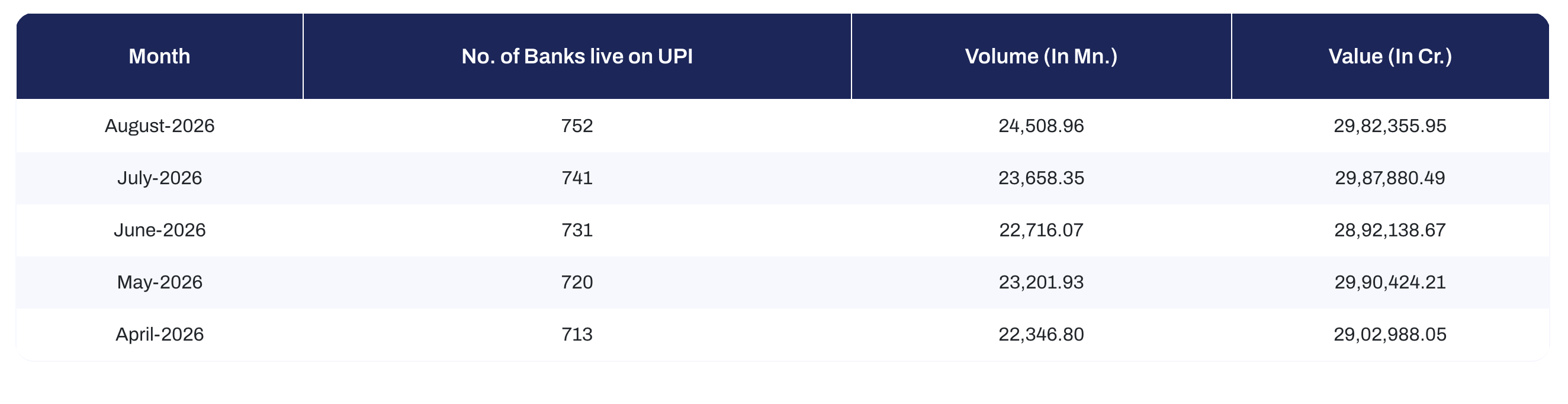
Source: NPCI
UPI has reduced the friction of transactions incredibly. The unbanked in India, which sat at 50% in 2009, is now down to 10%.
Low-value transactions have become incredibly simple. Before UPI, if you did not have change, you had to simply forfeit the balance to an auto driver or several such merchants. How many of us were handed a couple of candies by a shopkeeper because he did not have change? So much so that Parle, a company that manufactures a lot of toffees in India, saw a decline in its business after UPI was introduced.
Coming to MDR on UPI. The government has proposed a 0.4% MDR, which is a fifth of what every merchant pays today for each card transaction. I do not know what the brouhaha is all about. The benefits that the technology has already delivered to the country are phenomenal. The technology that powers UPI has an underlying cost, and this cost cannot be wished away.
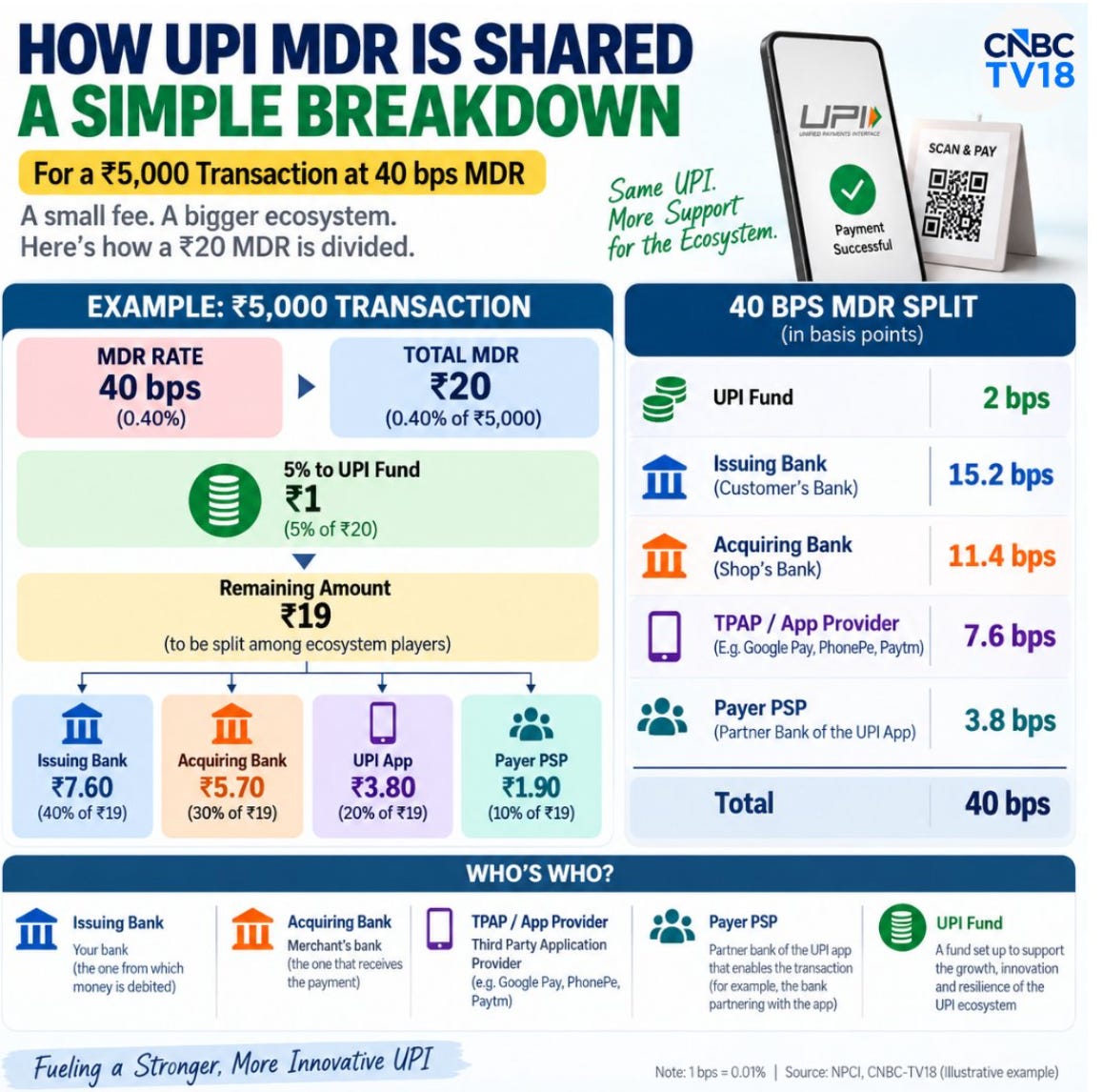
If you process Rs. 1 Crore in transactions at 0.4%, the total revenue generated is Rs 40,000, assuming all transactions are above Rs 2000 and below Rs 75000. All transactions below Rs 2000 are not chargeable; all transactions above Rs 75000 will trigger the Rs 300 max limit, and all peer-to-peer transactions are exempt. Essentially, you have to be a registered business running a payment gateway and receiving money in your current account to trigger the MDR. In value terms, that represents merely 30% of the transaction value.
So in reality, a company processing Rs 1 Crore in transactions will generate a revenue of Rs 12000 through MDR. Do you know how much an engineer in Bangalore costs?
So the transfers you make to the auto guy, the kirana shop, etc., are not subject to MDR. A business that either uses a PoS machine or a payment gateway is a business that would be subject to the MDR.
So the hue and cry!
I suppose this was bound to happen anytime the government chose to pass on the cost of running UPI. You would be foolish to believe that there are no transaction costs of using other modes.
All card transactions, as already explained, are subject to 5 times the MDR.
NEFT, RTGS, etc all attract their own charges, albeit lower; they are also high-friction modes of transfer. I would love to see people standing around at a store adding the store’s account details to make NEFT transfers.
Cash has its own transaction cost, and an associated toffee economy.
There are a bunch of things that this government does that I do not like. But this is a very calibrated, thoughtful and necessary step taken, in my opinion.